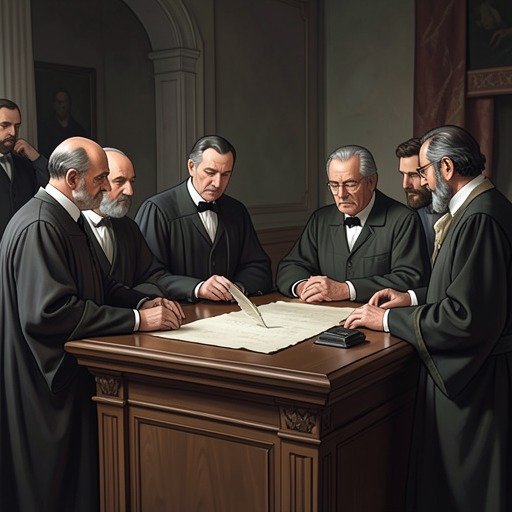
United States Senate
Federalist PapersThe United States Senate is the proposed Constitution’s chamber of state representation and a pivotal link between the state governments and the national government. In the essays, its equal vote for each State protects the states’ residual sovereignty, while its concurrence checks legislation and its participation in treaties, appointments, and impeachment gives it a distinct role in national government. The case for the Senate rests on a balancing act: it is meant to restrain the federal system without leaving the Union dependent on the states’ uncertain cooperation.
Structure and Federal Character
The Senate is one half of a legislature built on two different principles of representation. The House of Representatives speaks for citizens, giving larger States greater weight; the Senate represents the States, granting them equality. The proposed system is therefore described as a compound republic, combining proportional representation of the people with equal representation of the States. Equal suffrage is not treated as an abstract ideal but as the product of a political compromise between large and small States, without which a common government with powers suited to its purposes might not have been secured.
That compromise has a constitutional consequence beyond the allocation of seats. Each State’s equal vote recognizes the portion of sovereignty that remains with the individual States and helps preserve it against an improper consolidation into a single, simple republic. At the same time, the Senate’s state-based composition adds a second requirement for legislation: a measure must obtain the support of a majority of the people’s representatives and a majority of the States. This barrier may obstruct useful laws as well as harmful ones, but the essays defend it as a potentially valuable restraint in a political system especially liable to excessive lawmaking.
The Senate also serves as an institutional link between the two levels of government. State legislatures choose senators, giving the State governments a direct part in forming the national government and, in the essays’ account, securing their authority within it. State legislatures also participate in the appointment of the President through the electoral process. More broadly, the federal branches are expected to owe some measure of their existence to state influence: even representatives chosen directly by the people are elected in an environment shaped by people influential in state politics. The essays contrast this dependence with the relative independence of state governments from federal appointment, arguing that the imbalance makes the federal government more likely to defer to the States than to dominate them.
Representation, Qualifications, and Continuity
The Senate’s qualifications are more demanding than those for the House. A senator must be at least thirty years old and have been a citizen for nine years; a representative must be at least twenty-five and have been a citizen for seven. The essays justify the distinctions by the Senate’s responsibilities: its members are expected to bring broader information and steadier character, and the chamber participates directly in transactions with foreign nations. The nine-year citizenship requirement is presented as a middle course—neither excluding adopted citizens whose abilities may serve the public nor admitting them so hastily that foreign influence might enter national councils.
The six-year senatorial term and staggered rotation are designed to make the chamber continuous without making it unresponsive. One-third of the seats are vacated and replenished every two years, rather than the entire body facing replacement at once. Each State may have no more than two senators, and a quorum consists of sixteen members. These features figure in the defense of the Senate against the possibility that State legislatures might interrupt their appointments: a temporary combination of a few States, the essays argue, could neither abolish the chamber nor prevent it from acting.
The House faces a different exposure because its members are elected every two years. If State legislatures had exclusive power to regulate those elections, every election period could become a national crisis, potentially threatening the Union if leaders in a few important States conspired to prevent an election. The comparison clarifies the Senate’s double character: State legislative appointment gives the States a deliberate place in national government, while the Senate’s longer, staggered terms reduce the risk that temporary state-level obstruction will disable the federal legislature.
Legislative Check and Public Trust
The Senate is defended as a second legislative body that makes usurpation or perfidy harder. A scheme that might succeed through the ambition or corruption of one assembly must secure the concurrence of two distinct bodies. The essays argue that the likelihood of a sinister combination falls when the chambers differ in character, while still maintaining enough harmony to agree on proper measures. The Senate’s state-based composition thus supplies a check not merely by adding another vote, but by placing a differently constituted body between a proposal and its enactment.
That check has a built-in tension. The Senate’s equal state representation protects smaller States, but it can also let them resist measures supported by a popular majority and the more populous States. The essays answer that the House, backed by the larger States and the known will of a majority of the people, would possess considerable advantage in a contest between the chambers. The larger States could also use their influence over supplies to defeat unreasonable exertions of the smaller States’ legislative prerogative. The case is not that equal representation carries no risk; it is that the constitutional balance may be more workable than its critics assume.
The chamber’s relation to popular trust is also treated as a question of accountability. The essays distinguish the Senate from the House, whose members draw directly from the people, and argue that two distinct legislative bodies increase security by requiring agreement across different institutional interests. Elsewhere, the defense of the broader system insists that those entrusted with office must remain answerable for what they do. The Senate’s checks are therefore presented not as a substitute for public judgment but as safeguards that make it harder for a single body’s ambition or corruption to prevail unchecked.
Treaties, Appointments, and Impeachment
Treaty-making is one of the Senate’s most consequential responsibilities. The President is to make treaties by and with the Senate’s advice and consent, provided that two-thirds of the senators present concur. Because treaties concern war, peace, and commerce, the essays argue that this authority needs safeguards ensuring that it is exercised by capable people and for the public good. They defend the proposed selection of the President through electors chosen for that purpose and senators through State legislatures, contrasting these methods with elections in which party zeal may exploit voters’ inattention, ignorance, hopes, or fears.
The Senate also participates with the executive in appointments. In the proposed arrangement, the President holds the power of nomination, and each nomination is submitted to the judgment of an entire legislative branch. The essays favor this division over the New York appointment system, where a council of three to five people, including the governor, meets privately. Although the governor claims a power of nomination under ambiguous constitutional language, outsiders cannot readily determine how far that power extends, when the governor is opposed, or who is responsible for a particular choice. The resulting uncertainty, the essays contend, makes blame for a bad appointment less pointed and durable and leaves room for cabal and intrigue.
By contrast, a public and identifiable division of responsibility makes judgment possible. A bad nomination would be attributable to the President; rejection of a good nomination would be attributable to the Senate; if an unsuitable appointment went through, both would bear reproach, though in different degrees. The Senate’s power to obstruct a nomination is meant to restrain the executive, not to erase the executive’s role. This arrangement is defended as a way to preserve the advantages of executive nomination while making the Senate’s intervention visible and politically accountable.
The Senate has a separate judicial character as the court for impeachment trials. Impeachment concerns misconduct by public officials and violations of public trust—offenses that are political because they involve injury to society itself. Their prosecution can agitate the whole community, divide it into parties, and enlist existing factions on opposing sides. The danger is that judgment may follow the comparative strength of parties rather than the evidence of innocence or guilt. The Senate’s impeachment function therefore places it at the intersection of public accountability and partisan conflict: it is entrusted with judging abuses of public office, yet does so in cases liable to arouse the very factional pressures that can distort judgment.
Independence, Responsibility, and Constitutional Limits
The Senate operates within a larger system whose parts are meant to check one another. The essays argue that each department needs a will of its own and should have as little agency as possible in appointing the others. Complete separation is difficult and some departures from the principle are necessary, but dependence between branches must not render their independence merely nominal. Constitutional safeguards are meant to provide each department with both the means and the personal motives to resist encroachment.
That concern with responsibility extends to the risks of collective executive power. The essays warn that dividing executive authority among several people can conceal faults: amid mutual accusations, the public may be unable to determine who deserves blame or punishment for a harmful measure. Their contrasting defense of executive nomination and Senate review emphasizes the value of identifiable actors. The President’s responsibility for a nomination and the Senate’s responsibility for rejecting or approving it are meant to leave the public able to distinguish their parts in the outcome.
The Senate’s authority, like that of every federal institution, is limited by the Constitution. The essays defend the Necessary and Proper Clause as authority to enact laws for carrying out powers already granted, not as an independent source of unlimited power. They likewise explain that federal laws are supreme only when made pursuant to the Constitution; an act that invades the States’ remaining authorities is usurpation, not valid supreme law. The Senate’s participation in national government thus takes place within a constitutional division of authority rather than above it.
This principle of bounded authority is reinforced by the argument for independent courts. In a limited Constitution, courts must be able to declare acts contrary to the Constitution void; otherwise, enumerated limits on legislative power would have no practical force. The Senate is not the final measure of constitutional authority simply because it participates in legislation, appointments, treaties, and impeachment. Its significance lies instead in its place within a structure that distributes power, makes responsibility more visible, and preserves both national capacity and the States’ constitutional role.